Paper is one of the first things you notice when you hold a letterpress invitation. Before choosing it, look beyond the weight listed on the quote. The paper's surface, colour, thickness and printed result all deserve a closer look.
You do not need to become a paper specialist. A few clear questions can help you understand the options and choose a stock that suits your design.
What does gsm tell you?
Gsm means grams per square metre. It describes the mass of a standard area of paper, so it gives you a consistent way to compare paper weights.
Thickness is a separate measurement, often called caliper. It may be given in microns, millimetres or points. OKI's guide to paper weight explains these different measurements.
When a quote gives a gsm figure, ask which paper it describes. Keep the stock name, colour, finish and weight together. If thickness is important to your choice, ask for that specification as well rather than converting the gsm figure into millimetres yourself.
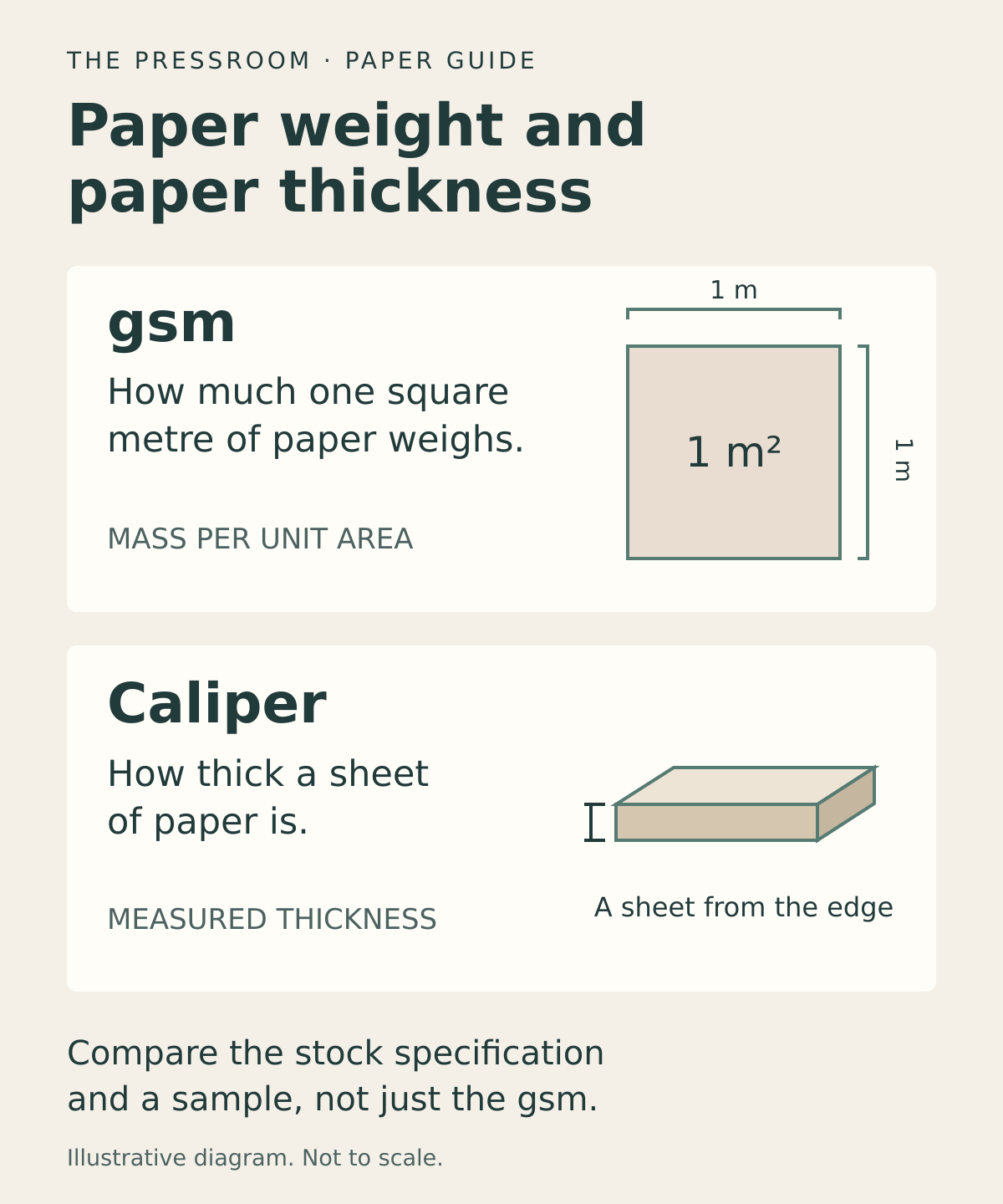
Weight and thickness describe different qualities. Compare the stock specification and a sample rather than choosing by gsm alone.
Compare samples with a clear purpose
Ask what samples are available and what each one can show you. A blank piece helps you assess the paper itself. A printed example lets you look at the ink, lettering and impression together. A proof for your own order may serve a different purpose again.
Check whether an example uses the proposed paper and print approach. If something differs, note it before making your decision. A sample can be useful without being an exact preview of your invitation, provided you understand the difference.
When comparing papers, place them side by side in the same light. Look at the colour and surface, then pick each one up. Write down what appeals to you: a warmer white, a smoother surface or a more substantial feel. Those observations are more useful in a design conversation than a request for the highest possible paper weight.
Look at the print as well as the paper
On a relevant printed sample, check the smallest lettering, any fine lines and the larger areas of ink. Turn the card over too, particularly if your design includes printing on both sides.
Talk about the result you prefer rather than requesting the deepest possible impression. For example, Neenah's cotton-paper production guidance warns that large areas of heavy impression can make a sheet curl or distort. That is a useful reason to discuss the actual artwork and paper with the printer, rather than treating impression depth as a quality score.
A photograph or screen proof cannot let you feel the surface. Ask which qualities the proof demonstrates and which need a separate discussion before approval.
Consider every piece in the suite
The main invitation, details card and reply card each have a job to do. List the paper proposed for each piece and compare them together where possible. If you want the colours to match closely, make that part of the brief.
Check the intended card sizes and the envelope as a complete set. If you plan to write on an invitation or reply card, mention that before choosing the paper and layout. These practical details can be easy to overlook when you are concentrating on the main design.
Put the choice into your quote
Before approving the order, make sure the agreed paper is identified for each item. If you change a stock, ask for the revised specification and any effect on the quote or timetable to be recorded clearly.
Our wedding stationery quote checklist covers the wider scope, including pieces, quantities, design work and delivery.
The Pressroom creates custom letterpress wedding invitations and matching stationery for couples across Australia. A useful starting question is: “Which paper suits this design, and is there a sample that shows the result we should expect?”